You know that frustrating moment when your hair just won’t cooperate — and you can’t figure out why? Half the time, the real problem isn’t your products or your technique. It’s that you’re treating your hair like someone else’s hair.
Knowing your hair type is the starting point for everything. The right shampoo, the right cut, the right drying method — all of it changes based on what you’re actually working with. Once you know that, mornings get a whole lot easier.
The System Behind Hair Typing
Back in the 1990s, celebrity hairstylist Andre Walker — known for working with Oprah Winfrey and Halle Berry — developed a hair classification system originally designed for his own product line. It caught on fast and became the most widely used hair typing framework in the beauty world.
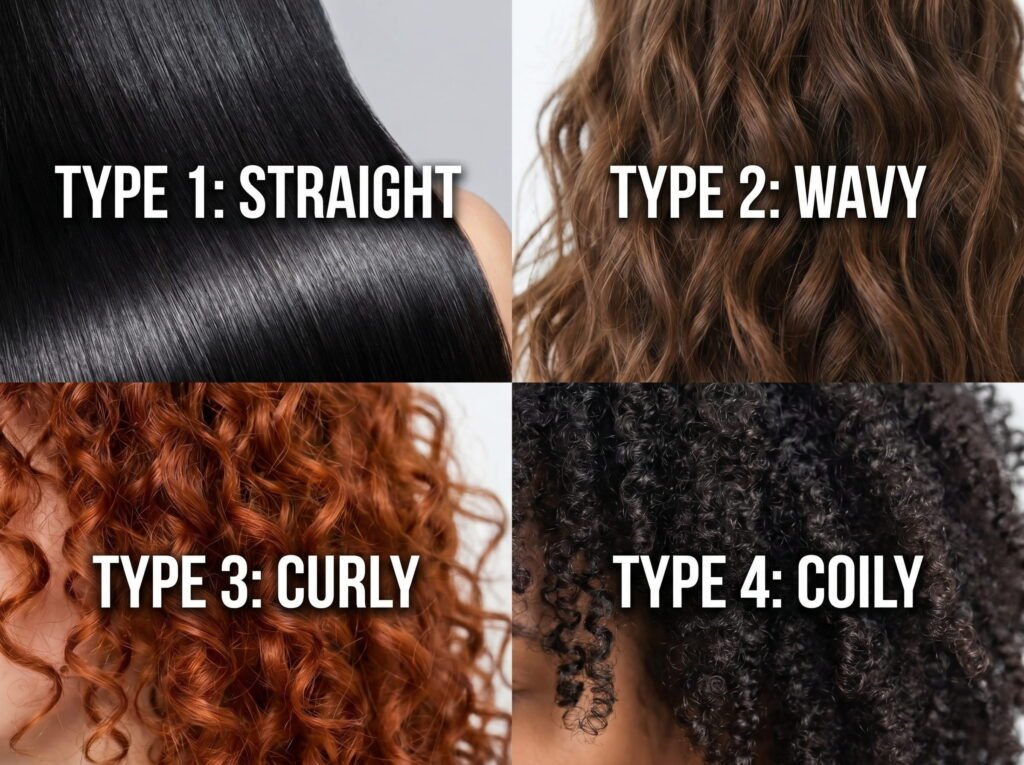
The system breaks hair into four main categories based on curl pattern, then divides each into three subtypes — A, B, and C — based on texture and thickness. That gives you nine distinct hair types in total.
To find yours, wash your hair, comb it gently, and let it air dry without touching it. However it dries naturally — that’s your actual hair type.
The Four Main Hair Types Explained
Type 1 — Straight Hair
Straight hair has zero natural curl. But not all straight hair is the same.
- 1A is fine, soft, and naturally shiny. The downside? It gets oily and greasy faster than any other type.
- 1B has more body near the roots, giving it a fuller look without being thick.
- 1C is genuinely thick with serious volume — but it resists curling almost completely. This subtype is especially common among women of East Asian descent.
Type 2 — Wavy Hair
Wavy hair sits right in the middle — not straight, not curly. It has an S-shaped pattern that ranges from subtle to pretty defined.
- 2A has a very light wave that curls slightly at the ends. It’s the most flexible type — easy to straighten or enhance into fuller waves.
- 2B has more visible S-waves that tend to sit closer to the head. It can get frizzy, especially in humidity.
- 2C is where wavy meets curly. The waves are thick, the volume is high, and frizz shows up quickly when the air gets damp.
Type 3 — Curly Hair
Type 3 hair has a clear, defined curl pattern that’s there even when your hair is dry.
- 3A has large, loose curls with a strong S-shape. It’s naturally shiny and responds well to different styles.
- 3B sits between spiral curls and tight corkscrews. The texture can vary across the head — sometimes finer in some sections, coarser in others.
- 3C has the smallest curl of the three. The curls are packed tightly, which makes the hair appear thicker even though individual strands are actually finer.
Type 4 — Kinky or Coily Hair
Type 4 hair has the tightest curl pattern of all — and the most fragile structure.
- 4A forms tight coils with an S-shape when stretched. The strands are fine and can break easily without the right care.
- 4B bends in sharp angles rather than curves, often with a Z-shaped or zigzag pattern. Like 4A, it’s prone to breakage.
- 4C has the least defined curl pattern of any type — which gives it incredible volume and shape, but makes combing a real challenge. It also has the highest shrinkage, meaning it looks much shorter when dry than it actually is.
How to Care for Your Hair Type
Knowing your type is step one. Knowing what to actually do with it is where it counts.
Straight Hair (Type 1) Care Tips
Your hair is already doing the shiny, soft thing on its own — you don’t need to add more oil to that. Skip the hair oils entirely.
What you should focus on is volume and cleanliness. Straight, fine hair picks up oil and dirt faster than any other type. Look for shampoos that contain curative clay — it helps absorb excess oil and keeps your scalp cleaner between washes. Exfoliating your scalp once a week also makes a noticeable difference.
For styling, cascade (layered) haircuts add the illusion of thickness without weighing your hair down. Your hair handles blow drying well, so feel free to use heat. That said, if you have 1A hair, you’ve probably noticed that curls don’t last long no matter what you do — so leaning into braids or a sleek ponytail on those days is a smarter call than fighting it.
Wavy Hair (Type 2) Care Tips
The goal for type 2 hair is simple: moisture without mess.
Shampoos and conditioners with moisturizing formulas are your baseline. If the ingredients include fruit extracts or herbal components, even better — these help maintain hydration without weighing waves down. On days when your ends feel dry, a tiny amount of grape or mustard oil worked into the tips will revive the wave without making it look greasy.
When drying, don’t fully blow dry — leave your hair slightly damp, or use cool air instead of hot. This helps the wave settle naturally rather than puffing up into a frizzy cloud.
One thing to keep in mind when getting a haircut: avoid extreme layering or dramatic transitions in length. If your cut requires a straightener every morning to look right, you’ve already lost the battle.
Curly Hair (Type 3) Care Tips
Hydration is everything for type 3 hair. Without enough moisture, curls lose definition and frizz takes over.
Essential oils are your best maintenance tool here — they lock moisture into the strand and prevent dryness throughout the day. When choosing shampoo and conditioner, always check the label for sulfates and silicones. Sulfates strip moisture aggressively, leaving your curls dry and puffy. Silicones coat the hair shaft and block moisture from getting in — the opposite of what you need.
A small but genuinely useful tip: sleeping on a silk pillowcase reduces friction overnight and keeps curls from getting tangled or matted by morning. Hairdressers regularly recommend it for curly hair clients.
Air dry whenever you can, and use cool air if you need to speed things up. Heat straighteners are especially damaging for type 3 hair — they weaken the strand over time and make frizz worse in the long run.
For haircuts, remember this rule: the shorter you go, the curlier your hair will appear. Also, always ask your stylist to cut your hair dry. Curly hair changes shape significantly as it dries, so cutting it wet often leads to unexpected results once it dries.
Kinky and Coily Hair (Type 4) Care Tips
Type 4 hair doesn’t get oily quickly, so you don’t need to wash it every day or even every few days. What you do need is a gentle shampoo and a strong conditioner.
On some days, you can skip shampoo entirely — wet your hair, apply conditioner, rinse, and let it dry. It sounds too simple, but the result is soft, moisturized hair without the stripping effect of a wash.
Essential oils are important here too, especially applied to the ends, which are the most fragile part of the strand.
Blow drying is manageable with type 4 hair — use cool air and spend about 10 to 15 minutes on it. Before you start, always blot out excess water with a towel. If you skip that step, the weight of wet hair pulls at the curl and you’ll lose shape.
The best lengths for type 4 hair are shoulder-length or longer. The “shorter equals curlier” rule applies here just as much as it does for type 3.
One Rule That Applies to Every Hair Type
Whatever category you fall into, there are two things that hold true across the board.
Take care of it consistently — not just when it looks bad. And work with your natural texture instead of against it. The people with the best hair aren’t the ones with a particular type. They’re the ones who’ve figured out what their hair actually needs and stopped trying to make it into something it isn’t.