Nobody needs another listicle telling them to “avoid long hair after 50” or warning that gray is “too aging.” Those rules are tired, and more importantly, they’re not even useful.
What actually helps is understanding why certain cuts work — and then deciding what fits your life, your face, and your style.
That’s exactly what this article is about. Five haircuts that consistently look great on women over 50, explained with the reasoning behind each one so you can make an informed choice rather than just follow someone else’s checklist.
Why Hair Changes After 50 (And What That Means for Your Cut)
Before anything else, it helps to understand what’s actually happening to your hair as you age.
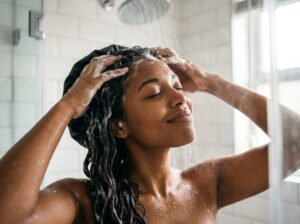
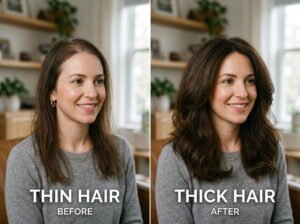
For most women, two things shift: the individual hair strand gets finer, and the overall density on the scalp decreases. The result is hair that looks wispy, feels harder to control, and loses the kind of volume it used to hold naturally.
This is extremely common. If you’ve noticed it, you’re far from alone.
The right cut can visually correct almost all of it. A skilled haircut doesn’t just change the shape — it changes how thick, healthy, and full your hair appears.
And that perception matters more than people realize, because thick-looking hair has a strong association with youth. It’s not vanity; it’s just how the eye reads things.
The 5 Best Haircuts After 50
1. The Blunt Bob or Lob

If you’ve ever been recommended a bob and wondered why everyone keeps suggesting it, here’s the actual reason.
When hair is cut into one clean, unlayered baseline — whether at chin length (bob) or just below the shoulder (lob) — the ends appear densely packed together.
That density reads as thickness. Even hair that’s genuinely fine looks full and healthy when the baseline is strong and uniform.
It works like an optical illusion, and it’s a surprisingly effective one.
You can wear it with or without a fringe. You can tuck it behind your ears or leave it loose. The base shape does the heavy lifting regardless.
If you have a softer jawline or carry more weight around the face and neck, a very short bob that hits right at the jaw might feel unflattering.
In that case, go with the lob — it gives you the same density benefit without drawing attention to that area.
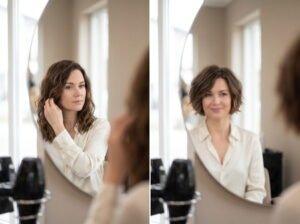
2. Mid-Length Cut with Long Layers

This is the cut that works on almost everyone.
The length sits somewhere between the collarbone and the shoulder, and the layers are kept longer rather than choppy.
The key detail is that most of the layering is concentrated toward the front of the face rather than distributed evenly throughout.
As the face loses elasticity over time, the skin along the jawline and neck begins to soften.
Layers that fall forward and frame the face create movement in exactly the right places — they draw the eye upward and contour the face naturally without any dramatic change in length.
At the same time, keeping the back layers light maintains enough density at the baseline that the hair doesn’t look thin from behind.
3. Adding a Fringe to Whatever Cut You Already Have
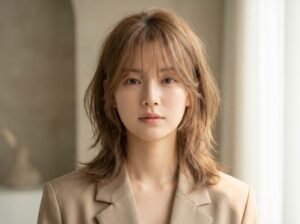
A fringe isn’t a separate haircut — it’s something you can add to almost any length you’re already wearing. And when it’s done well, the effect is significant.
A well-cut fringe makes the face appear smaller, minimizes forehead lines, and softens the area around the eyes. That last part is especially relevant for women over 50, since the eye area is often where fine lines and puffiness become most noticeable.
The word “well-cut” matters here, though. There’s a real difference between a fringe that flatters and one that doesn’t.
What tends to work:
- Airy, wispy fringes that sit lightly on the forehead
- Side-swept fringes that blend naturally into the rest of the hair
- Curtain bangs that open in the middle and grow longer at the sides — these can actually cover crow’s feet if worn correctly
What tends to be less flattering:
- Short, blunt, square-cut fringes that stop abruptly and draw sharp attention to the eye area
4. The Bixie

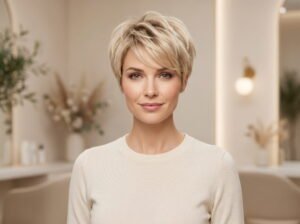
If you haven’t heard of it yet, the bixie is a hybrid between a bob and a pixie cut — shorter than a bob, longer than a classic pixie, with enough length on top to style in multiple ways.
It’s been trending for a reason. The cut is genuinely versatile.
You can wear it textured and tousled with a little pomade. You can smooth it out for something more polished.
You can keep the front longer and crop the back tighter for an edgier silhouette, or go for a slightly longer version that reads more like a short shag.
It’s one of the fastest cuts to blow-dry — which matters if you have any mobility concerns or simply don’t want to spend forty minutes on your hair every morning.
5. Working with Your Natural Texture
This one isn’t a haircut at all — but it might have the biggest impact of anything on this list.
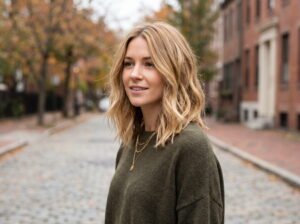
So many women spend years straightening, smoothing, or otherwise fighting their natural hair texture. What’s interesting is that letting go of that fight often results in hair that looks noticeably younger.
Natural texture — whether that’s waves, curls, or even just a bit of body — has an effortless quality to it. It suggests that you’re not overthinking your hair. And paradoxically, that relaxed appearance reads as youthful in a way that perfectly blown-out hair sometimes doesn’t.
You don’t have to wear your natural texture every day. Think of it as an additional option rather than a full lifestyle change.
Try it for a few days and see how your hair behaves when you stop working against it.
How to Talk to Your Stylist About What You Want
A lot of women feel uncertain about communicating with their hairstylist, especially when they can picture what they want but can’t describe it in technical terms.
Find a photo or video reference that shows the cut you’re after, and bring it with you. A visual reference removes all the guesswork.