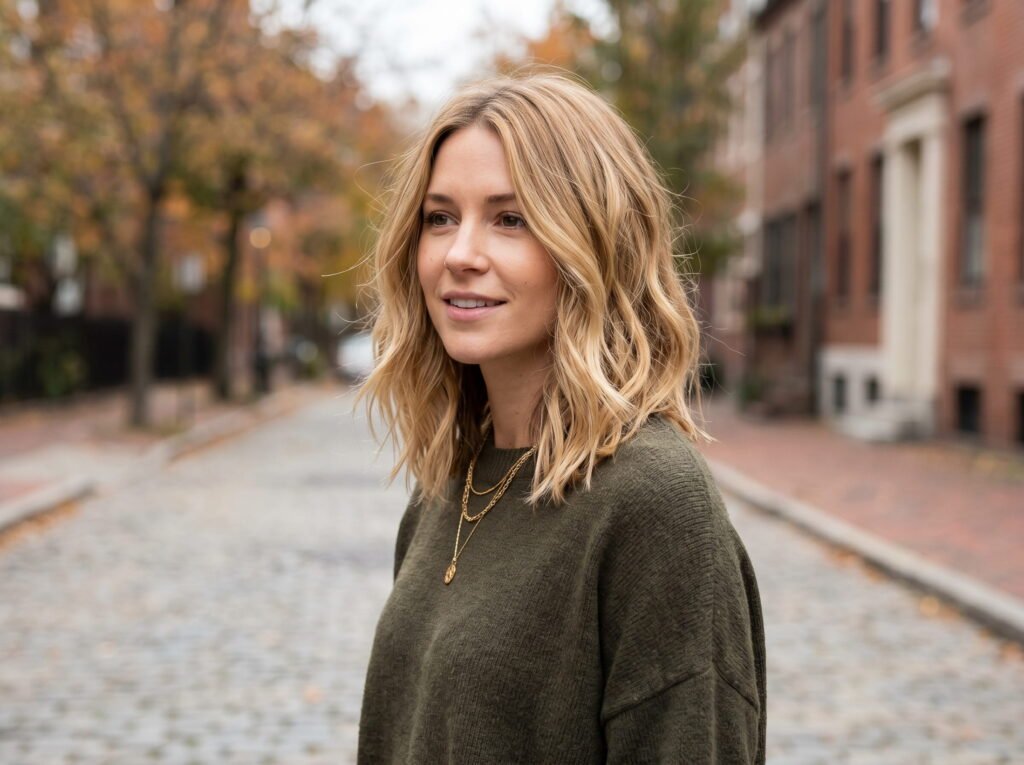
Before we dive in, here’s a quick way to check. Pull your hair completely back, stand in front of a mirror, and look at your face objectively. If your face is roughly as wide as it is long, your hairline is curved rather than angular, your jawline is soft and rounded rather than defined, and you don’t have prominent cheekbones or sharp angles anywhere — there’s a very good chance your face shape is round.
If that sounds like you, read on.
Best Haircuts for Round Faces at a Glance
Haircut 1: The Lob (Long Bob)
Haircut 2: The Shag
Haircut 3: The Angled Bob
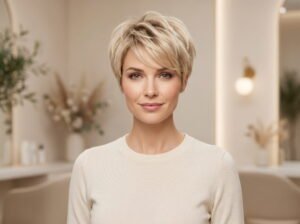
Haircut 4: The Textured Pixie
Haircut 5: Long Layers With Face-Framing Sections
1. The Lob (Long Bob)
The lob is a long bob that falls around the collarbone or just below, and it’s one of the most consistently flattering lengths for a round face. That extra length pulls the eyeline downward, which creates the visual impression of a longer, more balanced face shape without doing anything dramatic.
To really make it work, there are two things worth asking your stylist for. The first is a deep side part. It sounds simple, but a deep side part immediately creates more volume on one side of the head, which visually elongates the face and breaks up the circular symmetry in a really flattering way. The second is side-swept bangs, if you’ve been considering bangs at all.
A soft diagonal sweep creates a slimming line through the face and adds structure around the cheekbones — honestly not that different from how contouring works, just with hair. Side bangs are one of the few bang styles that consistently work well on round face shapes.
Without bangs, the lob still holds up beautifully. It works on straight, wavy, and curly textures, styles sleek or relaxed depending on the day, and has been a classic for a reason.
2. The Shag
The shag is having its moment right now and I’ve been recommending it constantly because when it’s done right, it flatters almost everyone — including round faces. The cut combines layers, choppy face-framing pieces, and volume at the crown, and that combination does exactly what a round face needs. Height at the top creates the illusion of facial length. Layering along the sides carves in shape and keeps the face from reading too wide or too heavy at the bottom.
Curtain bangs can work here, but with a caveat. Because they part in the middle, they can sometimes flatten the top and pull focus to the cheeks. When they’re styled properly — soft taper at the sides, a little lift at the roots — they can absolutely be flattering. The key is keeping some height at the crown so the overall shape still draws the eye upward rather than across.
3. The Angled Bob
If you’re drawn to something more polished and structured, the angled bob is a sharp and genuinely chic option for round faces. It’s cut shorter at the back and gets gradually longer toward the front, landing about an inch or two below the chin. That angled line creates definition, draws the eye downward, and adds a sense of length that balances out facial roundness beautifully.
One thing I always recommend for round faces with this cut: go slightly longer than the jawline. Anything that ends right at the chin can actually emphasize width, which is the opposite of what we’re going for. Keeping those front pieces a touch longer gives a face-framing effect that feels fresh and modern rather than blunt and boxy.
4. The Textured Pixie
A bold choice, but a genuinely flattering one when it’s done correctly. The textured pixie works on round faces as long as there’s volume at the crown and texture layered through the top. That lift visually elongates the face, and the movement through the texture adds structure so you get height where you want it and softness where you need it — not just a flat helmet of hair.
What to avoid is a super uniform, tightly styled pixie with no variation. That style compresses the face and actually makes it look shorter and rounder. The version that works is longer and more layered on top, tighter at the sides and back, which pulls the entire eyeline upward and brings real balance to the face shape.
5. Long Layers With Face-Framing Sections
For anyone who loves length and isn’t ready to go shorter, long layers with face-framing pieces are a soft and subtle way to add shape without losing what you love about your hair.
The most important detail here is where those first layers start. If your layers begin above or at the cheeks, you add width to exactly the wrong place. Starting the first layer just below the chin keeps things slim through the face and creates vertical movement through the length — that downward pull is what elongates and balances round proportions.
Face-framing pieces that taper in around the jawline or collarbone are especially good at drawing the eye downward. Style them with a slight bend that sweeps away from the face and you immediately get dimension, movement, and shape without anything drastic. They make a real difference without requiring much of a change at all.
The Common Thread in All of These
Every single cut on this list does one or more of the same things: adds height at the crown, creates length through the face, adds structure along the sides, or draws the eye downward and vertically rather than straight across the cheeks. That’s the framework.
Once you understand what you’re working toward, you can take any of these cuts to a stylist and have a really clear, specific conversation about how to make it work for your face.
Round faces are genuinely one of the most versatile face shapes to cut for. The options are wide, the results can be stunning, and a small shift in length or angle can completely change how your features read. If you’ve been frustrated with your hair, there’s a very good chance the right cut is closer than you think.

2 Responses