
I got my FUE hair transplant surgery a few years back, and during recovery, a third of my hair was shaved. Combined with already having extremely fine hair — which is exactly why I got the transplant in the first place — I genuinely felt like I had about five strands left on my head. I had no idea how to manage my appearance while waiting for everything to grow back.
So I went to my hairdresser and asked for help. What I walked out with was the most transformative haircut I’ve ever had. Not just for that situation — but as a long-term solution for fine hair in general.
After that experience, I started recommending this cut to my own fine-haired clients. Every single one of them came back saying the same things: it was flexible, easy to style, looked good even air-dried with natural texture, and made their hair look fuller than anything they’d tried before. So I wanted to break it down here properly, so you know exactly what to ask for when you walk into the salon.
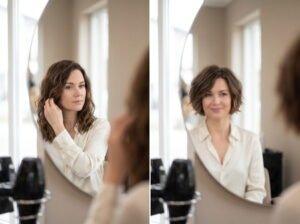
A Blunt Chin-Length Bob That Floats Above the Shoulder
That’s the full description. Not hitting the shoulder blade — floating just above it. And critically, it’s blunt. No layers whatsoever. Every single strand falls to the same line, and that uniformity is what creates the illusion of density and thickness.
Here’s what you need to tell your stylist, and why each detail matters.
Ask for It Cut in a Middle Part — Even If You Usually Side Part
This is the first and most important instruction, and a lot of people skip it.
A blunt cut means all your hair falls to the same baseline. If your stylist cuts it while you’re parted on the side, that entire haircut is calibrated to that specific part position. The moment you shift your part — even slightly — the hair on the heavier side starts to overhang the baseline.
It gets longer on one side, hangs past the line, and looks uneven. I see this constantly when I do bridal hair. Someone has a beautiful blunt bob, but they’ve varied their part by an inch, and suddenly there’s overhang everywhere.
Getting the cut in a middle part solves this entirely. It gives you full flexibility to style your part wherever you want without fighting the shape of the cut.
Request a Small Undercut at the Nape
At the very base of the neck, I always cut that first section just slightly shorter than the rest — barely half an inch, sometimes less. This creates a small cushion at the nape that the outer layers sit and cup into naturally.
Without this, what often happens with bobs is the weight at the base of the neck becomes too heavy and the ends start flipping outward. That flip-out is one of the most common complaints I hear about bobs, and this tiny undercut is the fix. It’s not dramatic enough to be visible, but it changes how the whole bottom of the cut behaves.
Just tell your stylist you want the nape section cut very slightly shorter than the rest so the hair cups in rather than flipping out.
Make Sure There’s a Slight Angle Forward
This is something that gets skipped more often than it should, especially by less experienced stylists. When a bob is cut completely flat — same length at the back as the sides — it creates a lifted, boxy effect at the front that looks dated and unflattering. There’s no modern flow to it.
Ask your stylist to keep the front very slightly longer than the back. Even a subtle angle forward changes everything. The two ways I typically achieve this: either freehand a slight angle with the scissors as I move from the center toward the sides, or hold the hair parallel to the floor and overdirect it slightly so that when it’s released, it naturally bevels forward.
Do Not Point Cut — Keep the Line Blunt
This one goes against a lot of stylist instincts. Point cutting — snipping into the ends at an angle to soften them — is almost automatic for most people doing a bob. But for very fine hair, you want to keep that line solid and sharp.
The bluntness of the baseline is what creates the optical illusion of thickness. That heavy, clean floating line is what tricks the eye into reading the hair as dense and full. The moment you start point cutting or softening the ends, you lose that effect. Ask your stylist specifically not to point cut, and explain that you want the blunt line preserved.
No Layers — At All
This goes hand in hand with keeping the baseline strong. For fine hair, layers are the enemy of the illusion we’re trying to create.
When you layer fine hair, you lift sections up and cut into them, which breaks up the baseline and weakens it. You lose the density at the ends, the hair looks thinner from the sides, and that clean strong line disappears. The whole point of this cut is that all the top hair falls down and meets that baseline, creating the appearance of a thick, glossy, full-looking result.
Finishing the Look
Once the cut is done, volumizing product and a good blow-out will take it the rest of the way. I like finishing with a little texture and bend in the ends for extra body — it works particularly well with this shape.
The cut does a lot of the heavy lifting on its own, though. That’s what makes it such a good solution for fine hair — it looks decent even air-dried, which is something most fine-haired people can’t say about their cuts. Natural texture works with the shape rather than against it.
What to Say When You Book
Walk in and say: “I want a blunt chin-length bob that floats above the shoulder, cut in a middle part. I want a small undercut at the nape to prevent flip-out, a slight angle forward so the front is just a touch longer than the back, no point cutting, and no layers at all.”
That’s everything your stylist needs. If they push back on any of it — particularly the no-layers instruction — explain that you have fine hair and you’re specifically trying to preserve the weight and the baseline. Any stylist familiar with fine hair will understand exactly what you’re going for.
This cut changed how I felt about my hair completely. I’ve watched it do the same for every fine-haired client I’ve given it to. If you’re struggling with fine hair and you haven’t tried this yet, it’s worth a conversation with your stylist.




One Response